Bloem: A Botanical Wildflower Dingbats Font for Creative Projects
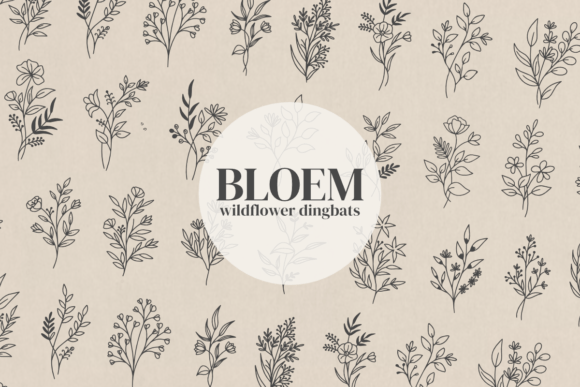
Finding a design asset that genuinely bridges the gap between nature and modern typography is a rare discovery. When I first encountered Bloem, I wasn't looking for just another typeface; I was searching for a way to inject organic vitality into digital layouts without sacrificing professionalism. Bloem is a unique botanical wildflower dingbats font, but calling it merely a "dingbats" set feels like an understatement. It functions as a visual language, offering a collection of intricate floral silhouettes that can stand alone or weave through your text. For designers, entrepreneurs, and content creators, this font represents a shift from standard clipart to integrated typographic art.
The Visual Personality of Bloem
At its core, Bloem captures the delicate asymmetry of wildflowers. Unlike rigid, symmetrical floral borders found in vintage clipart packs, this typeface embraces the natural movement of stems and petals. The style is distinctly botanical, featuring high-contrast linework that mimics fine pen illustration. Depending on how you use it, the aesthetic can lean toward a vintage botanical journal or a modern minimalist brand identity.
The personality of Bloem is elegant yet approachable. It avoids the stuffiness of traditional heraldic crests, favoring a fresher, more contemporary look. When you type a character, you aren't just getting a symbol; you are getting a composition. Some glyphs feature single, bold blooms, while others offer intricate bouquets or trailing vines. This versatility allows you to control the visual density of your design. It works as a premium font asset because of its attention to detail—every curve and leaf is vector-sharp, ensuring it scales beautifully from a small business card to a large-format poster.
Strategic Applications: Where Bloem Shines
Understanding where to deploy a creative font like Bloem is key to maximizing its value. It is not designed for body text; rather, it excels as a display font or an accent element. Here is how different professionals can integrate it into their workflow:
Branding and Logo Design
For small business owners in the wellness, beauty, wedding, or lifestyle sectors, Bloem offers a shortcut to sophisticated logo design. Instead of commissioning expensive custom illustrations, you can use specific glyphs from the font to frame a wordmark. For example, a wedding planner might use a trailing vine glyph to underline their business name. Because it is a vector-based typeface, it integrates seamlessly into Adobe Illustrator or Affinity Designer, allowing you to convert the text to outlines and tweak the anchor points to fit your specific layout. This helps in building a cohesive brand identity that feels curated and high-end.
Editorial and Packaging Design
In editorial design, white space is valuable, but visual breaks are necessary. Bloem serves as a sophisticated ornament for chapter headings in books or pull quotes in magazines. If you are working on packaging design for artisanal goods—such as tea, candles, or skincare—these botanicals add instant shelf appeal. Imagine a minimalist label where the only graphical element is a detailed wildflower from Bloem sitting atop the product name. It suggests that the product inside is natural, crafted, and premium.
Digital Presence and Social Media Graphics
The digital landscape is noisy, and stopping the scroll requires visual intrigue. Bloem is excellent for creating social media graphics that stand out. Content creators can use these dingbats as background patterns, corner accents for Instagram stories, or standalone art pieces to break up text-heavy carousel posts. For web design, these characters can be used as custom bullet points or dividers between sections, adding a touch of personality to an otherwise standard grid layout.
Typography Theory in Practice: Pairing and Hierarchy
A common mistake with decorative fonts is poor pairing. Because Bloem is highly detailed and organic, it requires a grounded counterpart. You generally want to avoid pairing it with a complex script font or a handwritten font, as the visual noise will compete for attention.
Instead, look for stability. A clean sans serif font is often the best companion. The geometric simplicity of a sans serif creates a beautiful contrast against the organic curves of the wildflowers. Alternatively, a sturdy serif font with a large x-height can work well for a more traditional, editorial look. The goal is to let Bloem be the "voice" of the design while the supporting typeface provides the "structure."
Visual hierarchy is also crucial. Use Bloem sparingly. If you use a large floral ornament as a header accent, ensure the body text is legible and unadorned. This creates a focal point that draws the eye in, then guides the reader to the content that matters.
Practical Guidance for Implementation
Before you fully integrate Bloem into your next project, there are a few practical considerations to keep in mind to ensure a smooth design process.
- Evaluating Project Fit: Analyze the tone of your project. Bloem fits perfectly with themes of nature, femininity, elegance, and organic craftsmanship. It may feel out of place in heavy industrial, tech-startup, or grunge-style designs.
- Testing Font Pairings: Before committing, mock up a few variations. Place a bold sans serif next to a Bloem glyph and see how the weight balances. Sometimes, you may need to scale the floral element down significantly so it doesn't overpower the text.
- Reviewing Styles: Check if the font family includes different weights or styles. Some botanical fonts offer "rough" or "stamp" textures alongside clean vectors. Choosing the right texture can change the vibe from "high-end boutique" to "rustic farmhouse."
- Readability Considerations: Remember that dingbats are pictorial. Do not use them for letters that need to be read as words. They are decorative elements. Ensure that any essential information is conveyed through standard legible typography.
- Commercial Licensing: Always verify the license. If you are creating a product for sale—like a mug, a printed t-shirt, or a template for resale—you need to ensure you have the appropriate commercial license. This protects you legally and supports the type designers who create these assets.
Elevating Your Creative Toolkit
In a market saturated with generic stock imagery, using a typeface like Bloem allows you to create custom graphics that feel exclusive. It empowers you to move beyond standard design templates and develop a visual voice that is distinctly yours. Whether you are a publisher looking for fresh chapter dividers, a crafter designing custom invitations, or a marketer building a nature-focused campaign, this font provides the tools to do so with elegance and ease.
Ultimately, the value of a premium font lies in its utility and its ability to inspire. Bloem is more than just a collection of flowers; it is a versatile design asset that brings the beauty of the botanical world into the digital realm. By applying these practical strategies, you can ensure that your projects not only look beautiful but also communicate your brand message effectively.