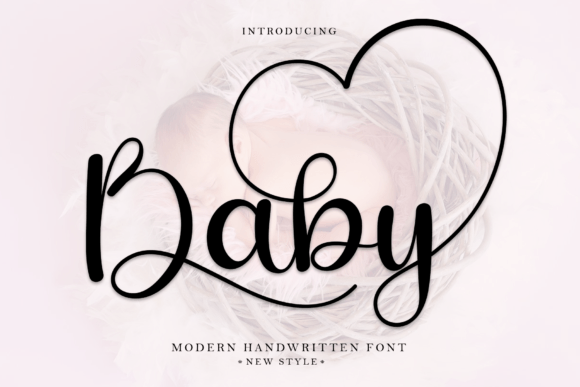
The Sweet Spot of Handwritten Style
When you are working on a project that requires a personal touch, generic fonts often fall flat. We have all seen the standard script fonts that look too rigid or the handwritten font choices that are illegible at small sizes. Baby strikes a balance that is surprisingly difficult to find. It is a premium font designed with round lettering and a distinct, crafted flow. If you are building a brand identity for a lifestyle blog, designing packaging design for a boutique product, or creating social media graphics that need to feel warm and inviting, this typeface offers a specific aesthetic that feels both modern and nostalgic.
Visually, Baby is characterized by its soft, circular forms. Unlike aggressive brush scripts that can feel chaotic, or rigid architectural fonts that feel cold, this typeface mimics the careful precision of a skilled hand letterer. The letter connections are thoughtful, ensuring that words flow together without creating visual knots. It is a creative font that avoids the "halloween" or "horror" vibes often associated with darker scripts, leaning instead into a friendly, approachable personality. It works exceptionally well in modern typography stacks where you need a display font to carry the emotional weight of the headline while a cleaner sans serif font handles the heavy lifting of the body copy.
Where This Typeface Shines
Understanding where to deploy a handwritten font is just as important as choosing the right one. Baby is incredibly versatile, but it has specific strengths. In editorial design, such as magazine headers or pull quotes, it adds a layer of intimacy that draws the reader in. For logo design, particularly for businesses in the wellness, beauty, food, or children’s sectors, it provides instant recognition. The roundness of the letterforms suggests safety and comfort, which is a powerful psychological tool in marketing.
Consider the world of packaging design. If you are a small business owner selling artisanal goods, your packaging needs to communicate quality and care. Baby can be used on labels to highlight key ingredients or the product name, creating a focal point that stands out on a shelf dominated by sharp, corporate serif font and sans serif font combinations. Furthermore, because this is a commercial font with extensive capabilities, you are not limited to basic text. The PUA encoding mentioned in its specifications is a technical feature with massive practical benefits. It means you can access special characters and ligatures in any software, even those that do not support advanced OpenType features natively. This allows you to swap out a standard "t" for a stylistic tail or connect specific letters in a unique way, giving your design a truly custom, hand-lettered look.
Technical Performance and Readability
A common pitfall with script font choices is prioritizing style over function. A beautiful font is useless if your audience cannot read it. Baby was crafted to produce desired results, which means the designer paid attention to legibility. The spacing between letters—the tracking—needs to be monitored, of course, but the letterforms themselves are distinct enough to be read at medium sizes. This is crucial for web design, where text is viewed on various screens and resolutions. It is an excellent choice for hero sections or banner text, provided you pair it correctly.
Speaking of font pairing, Baby pairs best with something grounded. Because it has so much personality, placing it next to another decorative font will result in visual noise. A clean, geometric sans serif font works perfectly for body text, providing a neutral canvas that lets the handwritten font stand out. If you are going for a more sophisticated look, a light-weight serif font can also work, creating a contrast between the organic nature of the script and the structured nature of the serif. When testing pairings, look at the x-height. You want a secondary font that matches the lowercase height of Baby to create a cohesive visual hierarchy.
Licensing and Practical Application
For designers and entrepreneurs, the practicalities of using a commercial font are non-negotiable. You need to know that the asset you are integrating into a client's brand identity or your own product line is legally cleared for that use. Baby comes with licensing that supports these commercial ventures. Whether you are printing it on t-shirts, using it in a digital course, or embedding it in a website, the rights are clear.
From a workflow perspective, the "ease of use" claim is valid. In the past, accessing ligatures required digging through glyph panels in Adobe Illustrator or InDesign. With PUA encoding, you can simply copy and paste the special characters from a character map directly into your text layer in Photoshop, Procreate, or even Canva. This democratizes high-end modern typography, allowing content creators and hobbyists to achieve professional results without needing deep technical knowledge of typography software.
Real-World Scenarios
Imagine you are a wedding stationer. You are designing a suite that includes a save-the-date, an invitation, and a menu. Baby can serve as the primary typeface for the names of the couple, providing that romantic, bespoke feel. You would then use a classic serif font for the details like dates and locations to ensure grandma can read the time of the ceremony.
Or, consider a digital marketing scenario. You are creating a Facebook ad for a flash sale. You need the word "SALE" or "50% OFF" to pop immediately. Using Baby with a slight drop shadow or a contrasting background color grabs attention faster than a standard blocky font because the organic shape stands out against the grid-like layout of most social media feeds.
Final Thoughts on Selection
When evaluating Baby for your next project, print it out. View it on your phone. Test it in all caps and in sentence case. Look at how the "b" connects to the "a" and how the "y" drops below the baseline. These small details are what separate a generic design asset from a premium font. It is a tool that adds warmth, personality, and a human touch to digital and print media, making it a valuable addition to any designer's toolkit.